Britain's National Wealth Fund announced a £113 million equity investment in UK-headquartered defence technology company UFORCE on 12 November 2026, part of a $700 million fundraising round intended to scale Ukrainian-developed unmanned systems in Britain. The fund's announcement describes its largest defence investment to date, while the Ministry of Defence says the company plans more British manufacturing and skilled jobs. This is an investment in a company and its capacity, not an announcement that the Royal Navy has purchased £113 million worth of drones.
Key facts
- The National Wealth Fund is investing £113 million, or roughly $150 million, in equity within UFORCE's $700 million Series A.
- UFORCE develops autonomous systems across sea, land and air, including its MAGURA MV7 and MV11 uncrewed boats and NEMESIS technology.
- The company expects more than 70% of the content of each UK-built MV-series boat to come from British suppliers.
- Hundreds of skilled UK jobs and apprenticeships are planned, but the announcements do not provide a completed-hiring total or a detailed factory production timetable.
What the public investment buys
The publicly owned National Wealth Fund is participating as an investor in UFORCE's capital raise. That distinction matters: an equity stake can help finance a company's expansion without being the same transaction as a defence ministry procurement contract. Neither official announcement gives a unit price for the boats, a fixed order quantity from the British armed forces or a date on which new British-built vessels will first be delivered. The fund identifies the investment as supporting domestic industrial and technological capacity.
The total fundraising round is much larger than the British public investment. The £113 million figure is the fund's participation; $700 million is the whole Series A, involving other investors. The Guardian reported that Valor Equity Partners was another lead investor and placed UFORCE's company valuation at about £4.5 billion. That valuation is a reported financing figure, not a measure of contracts already awarded, production completed or sales revenues earned.
UFORCE was founded by Ukrainians and is headquartered in London. Its portfolio combines software and command-and-control technology with remotely operated vehicles. The fund says the expansion will cover engineering, production, software, training and support for customers in Ukraine, Britain and allied countries. Its statement names the MAGURA family and NEMESIS systems, but does not say every model will be made at the same British location.
Why production in Britain matters
The new industrial emphasis is the promised British supply chain. According to the government, hulls, engines, electronics and fitting-out will be sourced domestically and more than 70% of each UK-built boat's content will come from British suppliers. That is a forward-looking sourcing commitment. It does not establish that every boat now manufactured by the firm already meets that threshold, nor does it mean 70% of the investment itself must be spent within Britain.
UFORCE says it will expand its British teams and sponsor apprenticeships with universities and colleges. The expected employment gain is described as hundreds of high-skilled roles in engineering, artificial intelligence, software and advanced manufacturing. Specific hiring numbers, sites, milestones and independently measured supply-chain spending will be needed to judge whether these ambitions have been achieved.
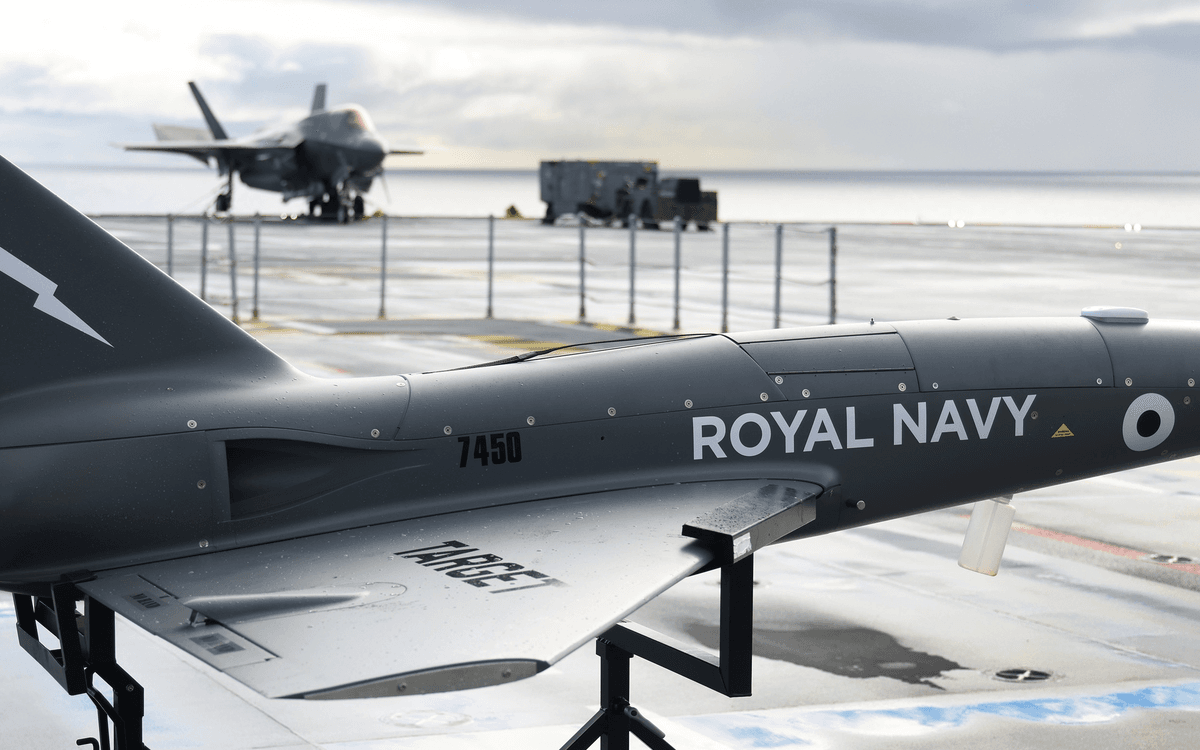
The defence context is also concrete. During a visit aboard the aircraft carrier HMS Prince of Wales in Norway, Defence Secretary Wes Streeting remotely piloted a UFORCE MV7 uncrewed surface vessel operating in the Atlantic near Portugal, more than 1,500 miles away, according to the ministry. The demonstration illustrates the distance over which a vehicle can be controlled; it does not by itself prove readiness for every mission or establish the reliability of command links under combat conditions.
The planned investment connects two directions of the UK-Ukraine relationship. Britain has provided assistance to Ukraine during the war. Here the government is also seeking to bring Ukrainian-developed combat experience, engineering and intellectual property into a British industrial base, while retaining capacity to support Ukrainian requirements. The fund explicitly connects the deal with the bilateral 100-year partnership.
For British industry, the test now is execution rather than the fundraising headline. Future evidence would include factories and training operations actually expanded, British component orders placed, apprentices recruited and vessels delivered. For defence planners, a separate question is whether any military buyer subsequently signs procurement and maintenance contracts. The announced transaction establishes the financing commitment and strategic plan, not those later outcomes.