The Federal Aviation Administration lifted a nationwide halt on U.S. aircraft departures on Friday evening, 13 November 2026, after communications failures affected multiple air-traffic control centers. The stop began around 3:54 p.m. Eastern time, according to contemporary reports, and airspace reopened at approximately 8:15 p.m. The order protected aviation safety during uncertain controller-to-pilot communications; it did not require every aircraft already in the air to land immediately.
The outage left airlines with diverted aircraft, delayed travelers and crews scattered across airports. Although departures began resuming on Friday night, reopening the network did not clear the accumulated backlog or establish a final technical cause.
Key facts
- The FAA attributed the original nationwide ground stop to communications problems at multiple Air Route Traffic Control Centers.
- Authorities lifted the departure restriction after roughly four hours and twenty minutes on Friday evening.
- Aviation data company Cirium counted 827 diversions by 7:05 p.m., including 670 flights returning to their original departure airports, according to Associated Press reporting.
- U.S. officials reported no indication of a cyberattack but said the technical investigation was continuing.
Why communications trouble led to a nationwide halt
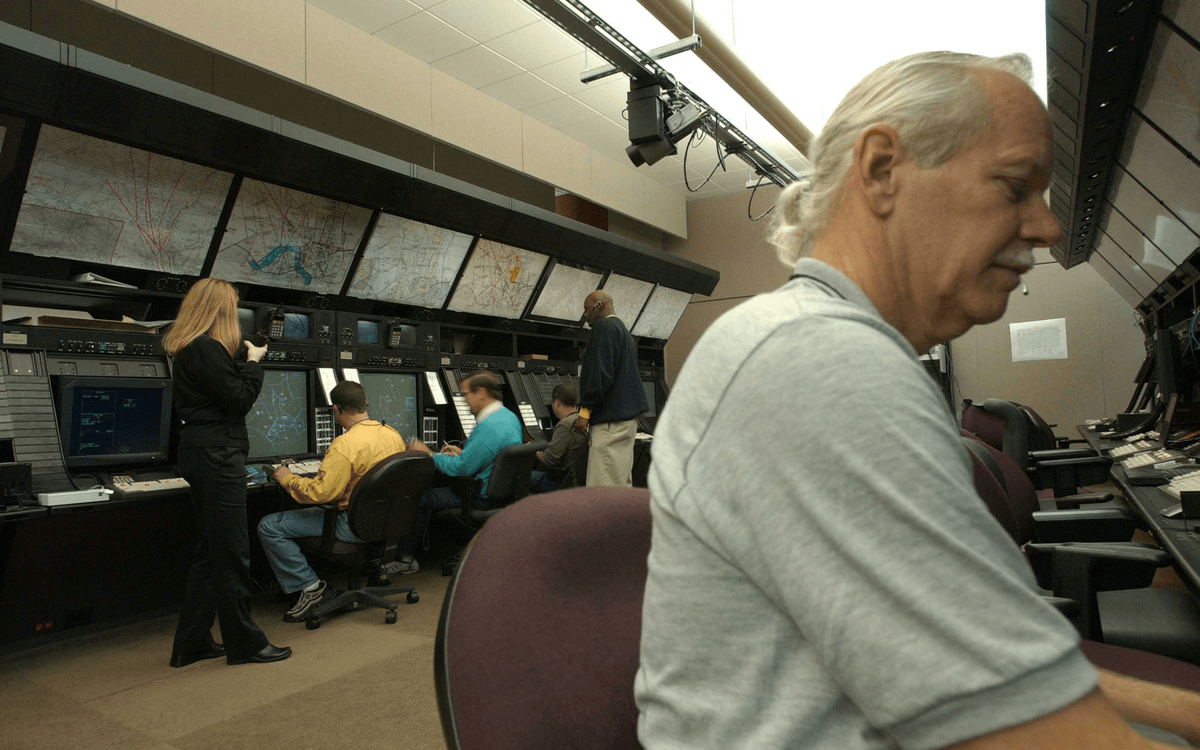
Air traffic controllers rely on dependable communications to instruct pilots and maintain safe separation. The FAA's own preliminary notice described a problem spanning multiple control centers, not a single airport's local weather or runway conditions. When the ability to communicate across the network is unstable, permitting additional aircraft to depart could increase risk and complexity as engineers investigate.
A ground stop is different from closing every airport or grounding each plane already airborne. Aircraft already in flight could still be handled and landed; new departures were held. Airports faced secondary problems when diverted and delayed aircraft occupied gates out of sequence. International travelers and connecting itineraries were exposed too, because a disrupted U.S. aircraft rotation can affect subsequent journeys to Canada, Britain and continental Europe.
The FAA's initial notice expressly described its information as preliminary. Later Friday, Homeland Security Secretary Markwayne Mullin and Transportation Secretary Sean Duffy said older systems had been overwhelmed during introduction of newer equipment. Mullin said investigators had found no sign of a deliberate attack. That is the officials' initial account, not an independently published technical root-cause report.
Duffy separately said that the FAA's newer artificial-intelligence flight-prediction system was not connected to the equipment that failed. It would therefore be inaccurate to label the stoppage an AI failure without new evidence. What was directly established is the loss of reliable communications and the FAA's precautionary decision to hold departures.
Flights resume, but delays can propagate for days
Associated Press reported that more than 3,000 flights landed safely during the stoppage. Cirium recorded hundreds of diversions by early evening, and thousands of flights were caught in the wider schedule disruption. The approximately 11,000 flights and 1.5 million travelers scheduled to depart after 4 p.m. represent potential exposure, not a verified final count of cancellations or stranded passengers.
An aircraft arriving hours late may miss its next departure, while pilots and cabin crews can reach legal duty-time limits. Airports must also find gates for traffic arriving in the wrong order. Such operational problems can persist after communications are restored. Airline recovery times will differ by airport and carrier, and the cancellation total remained fluid on Friday night.
Cargo movements depend on the same aircraft and crew networks. Express parcels, medical supplies and other time-sensitive shipments may require rerouting when overnight rotations are disrupted. That possibility does not justify inventing a specific financial loss or claiming that every shipment was delayed; the final logistical consequences were not yet measured.
The incident underscores longstanding weaknesses in U.S. aviation infrastructure. A separate nationwide ground stop in January 2023 followed failure of a pilot-notice distribution system, while regional communication disruptions have caused other delays. Those incidents involved different systems and do not establish that Friday's failure shared the same cause.
The administration says modernization is underway, with thousands of copper wires being replaced by fiber-optic lines and hundreds of radio systems upgraded. AP reported that Congress previously approved $12.5 billion for the overhaul and officials were seeking another $30 billion. Those figures describe an infrastructure funding debate, not a repair estimate for this specific outage.
The next checkpoints are the FAA's technical findings, reliable restoration of controller communications and the carriers' updated operating schedules. The lifting of a national restriction is not confirmation that any particular flight will depart on time.